

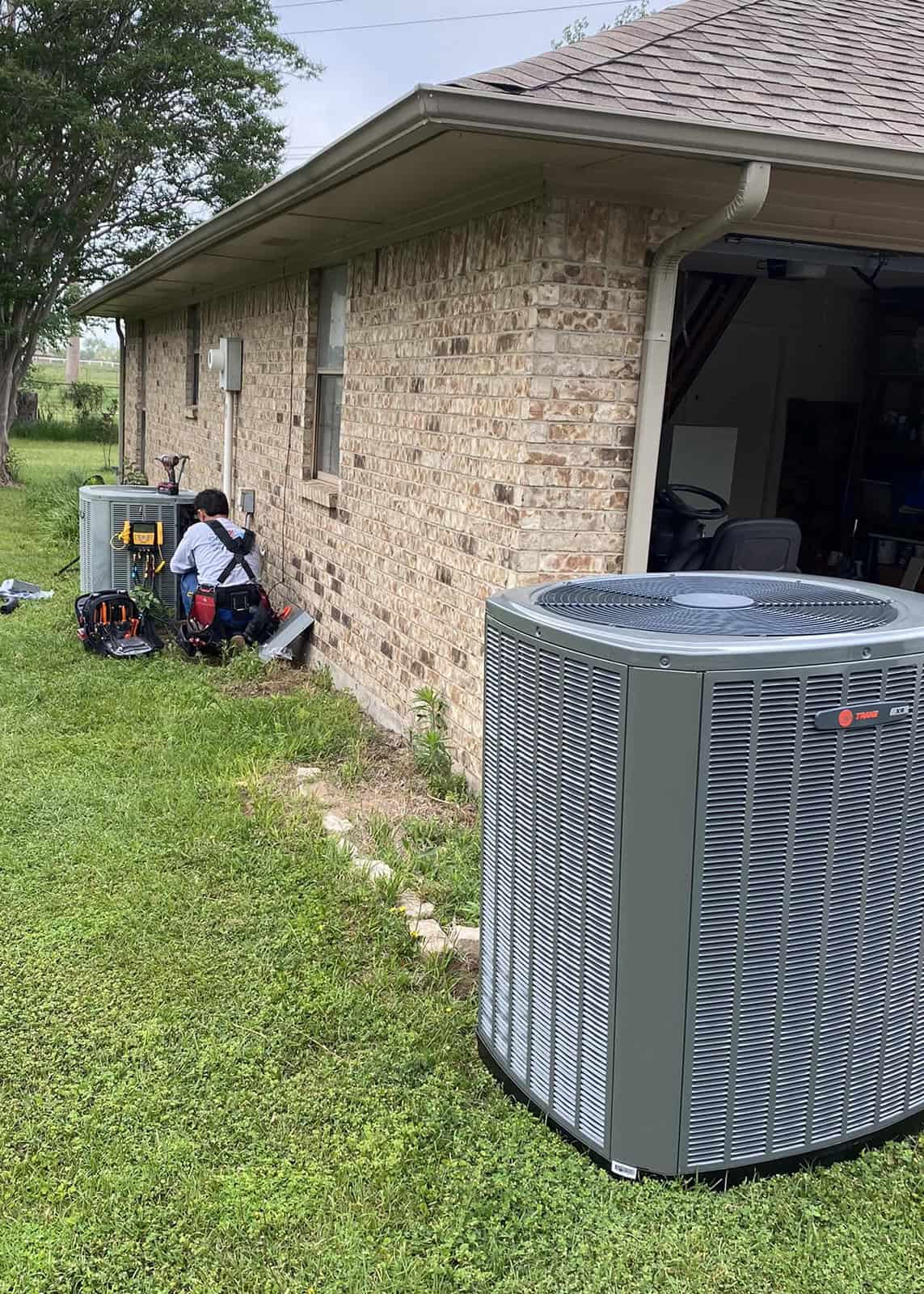
DFW Summer Heat Is Driving Up Your Electric Bill
Let’s talk about those Texas electric bills for a minute. If you live in the Dallas-Fort Worth metroplex, you already know the drill: May rolls around, the temperature hits the 90s, and suddenly your electric bill shoots up like a rocket. By July, when we’re dealing with week after week of 100-degree days, that monthly bill can feel like a second mortgage payment.
Here’s a sobering fact: North Texas typically sees 15-25 days per summer over 100°F (varying by year), and your air conditioner is working overtime during every single one of them. Texas homeowners in the DFW area can spend a significant portion of their annual electricity budget—often $1,500-2,500+ per year—on cooling costs during our brutal summers.
If your AC unit has been chugging along for 10, 15, or even 20 years, I’ve got news for you: it’s the biggest energy hog in your house, and it’s costing you hundreds (maybe thousands) of dollars more than it should every single year.
“But it still blows cold air!” you might be thinking. And you’re right—it does. But here’s the thing: your old AC is like driving a 1995 pickup truck. Sure, it still runs, but it’s guzzling gas while a modern vehicle would get you twice as far on half the fuel. That inefficiency is exactly why upgrading to a new, energy-efficient system delivers real new AC savings in Texas that you’ll see month after month.
What’s Really Making Your Old AC So Expensive?
Low SEER Ratings: The Hidden Cost
Let’s talk SEER—Seasonal Energy Efficiency Ratio. Think of SEER as the “miles per gallon” rating for your air conditioner. The higher the number, the less electricity your AC needs to produce the same amount of cooling.
Here’s the reality check:
- Pre-2006 AC units: Typically 8-10 SEER
- 2006-2015 units: Usually 10-13 SEER
- Minimum allowed today: 14-15 SEER (depending on region)
- Modern efficient units: 16-20 SEER
- Premium high-efficiency: 20-25+ SEER
If you’ve got a 10 SEER unit from 2005, it’s using 60% more electricity than a modern 16 SEER system to cool your home to the same temperature. Let that sink in: you’re paying 60% more to achieve the exact same result.
Constant On/Off Cycling Wastes Energy
Older air conditioners are single-stage systems, which means they only have one setting: full blast. They turn on at 100% power, cool your house down, shut off completely, then repeat the cycle over and over. Every time that compressor kicks on, it draws a massive surge of electricity—and all those start-up surges add up fast on your electric bill.
In the brutal Texas heat, your old AC cycles on and off frequently throughout the day during peak afternoon temperatures. Each startup uses as much electricity as running the system for several minutes, which means you’re wasting energy every single cycle.
Outdated Refrigerant (R-22 vs R-410A)
If your system was installed before 2010, it probably uses R-22 refrigerant (also called Freon). The EPA phased out R-22 production in 2020 due to environmental concerns, which means:
- R-22 is now expensive and hard to find
- If you develop a refrigerant leak, repairs are costly
- R-22 systems run less efficiently than modern R-410A systems
Modern AC units use R-410A refrigerant, which is more environmentally friendly and helps the system run more efficiently, using less energy to produce the same cooling power.
How Much Will a New AC Actually Save? Real Texas Numbers
SEER Rating Comparison: What You’ll Actually Pay
Let’s get specific with real numbers based on a typical 2,000 square foot home in the DFW area. Here’s what your monthly cooling costs look like during peak summer (June-August) based on different SEER ratings:
Example estimates based on typical DFW electricity rates ($0.12-0.14/kWh) and a heavily-used 2,000 sq ft home. Actual savings vary by home insulation, ductwork condition, thermostat settings, runtime, and usage patterns.
| AC SEER Rating | Monthly Cost (Summer) | Annual Cooling Cost | vs. 10 SEER Difference |
|---|---|---|---|
| 10 SEER (Old) | $320 | $1,920 | Baseline |
| 13 SEER | $246 | $1,477 | Save $443/year |
| 16 SEER | $200 | $1,200 | Save $720/year |
| 18 SEER | $178 | $1,067 | Save $853/year |
| 20 SEER | $160 | $960 | Save $960/year |
The bottom line: Upgrading from a 10 SEER to a 16 SEER system can save the average DFW homeowner around $720 per year. Over the 15-year lifespan of a new AC unit, that’s $10,800 in total savings.
Savings Breakdown by Home Size
Your home size makes a big difference in potential savings. Here’s what homeowners can typically expect based on square footage:
1,500 sq ft Home:
- Old 10 SEER monthly cost: $240
- New 16 SEER monthly cost: $150
- Monthly savings: $90 | Annual savings: $540
2,000 sq ft Home:
- Old 10 SEER monthly cost: $320
- New 16 SEER monthly cost: $200
- Monthly savings: $120 | Annual savings: $720
2,500 sq ft Home:
- Old 10 SEER monthly cost: $400
- New 16 SEER monthly cost: $250
- Monthly savings: $150 | Annual savings: $900
3,000 sq ft Home:
- Old 10 SEER monthly cost: $480
- New 16 SEER monthly cost: $300
- Monthly savings: $180 | Annual savings: $1,080
These electric bill savings from a new AC represent real money back in your pocket every single month—though actual results depend on your specific home, usage patterns, and how well-maintained your system is.
Modern AC Features That Slash Your Electric Bill
Variable-Speed Compressors: The Game Changer
Modern AC units with variable-speed compressors are like having a dimmer switch for your cooling instead of just an on/off switch. Instead of running at 100% or 0%, these systems can operate anywhere from 25% to 100% capacity.
Why this matters for your electric bill:
- Runs at low speed most of the time (using minimal electricity)
- Avoids constant on/off cycling and those energy-wasting startups
- Provides consistent temperature and humidity control
- Can save an additional 10-15% beyond SEER rating improvements alone, depending on how you use the system and how your home is built
During a mild 85-degree evening, your variable-speed AC might run at just 40% capacity, using a fraction of the electricity while keeping you comfortable.
Two-Stage Cooling
Two-stage systems are a step up from old single-stage units. They have:
- Low stage: Uses about 65-70% capacity for mild days
- High stage: Kicks to 100% only when needed on brutally hot days
This means your AC runs on the energy-efficient low stage about 80% of the time during the cooling season, significantly reducing your electric bills compared to a system that’s always at full blast.
Smart Thermostat Integration
New AC systems work seamlessly with smart thermostats like Nest, Ecobee, or Honeywell Home, which can:
- Learn your schedule and adjust automatically
- Reduce cooling when you’re away
- Optimize runtime based on electricity rates (if you have time-of-use pricing)
- Show you exactly how much energy you’re using
Many of our Forney customers report an additional 10-20% savings (a typical range for many households) just from smart thermostat optimization on top of their new, efficient AC unit.
Superior Dehumidification
Texas summers aren’t just hot—they’re humid. Modern AC systems remove humidity much more effectively than old units, which means:
- Your home feels cooler at a higher temperature setting
- You can set your thermostat 2-3 degrees higher and still be comfortable
- Less runtime = lower electric bills
Pro tip: Every degree you raise your thermostat saves about 2-3% per degree on cooling costs. If better dehumidification lets you go from 72°F to 75°F, you could be saving around 6-9% right there.
How Long Until Your New AC Pays for Itself?
This is the million-dollar question (well, the several-thousand-dollar question): when do you break even?
Here’s the ROI math for a typical 2,000 sq ft DFW home:
New AC System Cost:
- Average 16 SEER system: $6,000-8,000 installed (typical range for mid-2020s)
- Let’s use $7,000 as our example
Annual Savings:
- Replacing 10 SEER with 16 SEER: $720/year (based on our example)
- Additional savings from reduced repairs: $150-300/year (new systems have fewer repair costs early in their life)
- Total annual benefit: ~$900/year
Break-Even Point: 7-8 years
But here’s the kicker: A new AC system should last 15-20 years with proper maintenance. That means after you break even at year 7-8, you have another 8-12 years of pure savings—potentially $7,200-10,800 of additional savings over the system’s life.
If you finance at 0% APR:
- Monthly payment: ~$145 (60-month term on $7,000)
- Monthly savings: ~$75
- Out-of-pocket: $70/month
- After payoff: $145/month back in your pocket
Many of our Forney customers find that their monthly savings nearly cover their financing payment, making the upgrade much more affordable.
Factors That Affect Your AC Savings in Texas
Not every home saves the exact same amount. Here are the factors that influence your actual savings:
1. Current System Age & Efficiency
- Replacing a 20-year-old 9 SEER unit = massive savings potential
- Replacing a 10-year-old 13 SEER unit = moderate savings
2. Home Insulation Quality
- Well-insulated home: New AC savings maximized
- Poor insulation: Some savings lost through walls/attic
- (Consider attic insulation upgrades for even better results)
3. Ductwork Condition
- Leaky ducts can waste 20-30% of cooled air
- Sealing ducts + new AC = compound savings
- Learn about our duct sealing services
4. Thermostat Settings
- Every degree higher = roughly 2-3% savings
- Smart scheduling = automatic savings
5. Maintenance Schedule
- Regular tune-ups keep efficiency high
- Dirty filters can reduce savings by 5-15%
- Check out our AC maintenance plans
Smart Ways to Save on Your AC Investment
While federal tax credits expired at the end of 2025, there are still several ways to reduce your upfront investment:
Local Utility Rebates (Available Now)
- Oncor offers rebates for high-efficiency systems
- TXU and other providers have efficiency programs
- Typical rebates: $200-500
Financing
- 0% interest financing available (for qualified buyers)
- Flexible payment plans
- Make your upgrade affordable with monthly payments
- Explore financing options
Manufacturer Rebates (Seasonal)
- Carrier, Trane, and other brands offer periodic promotions
- Spring/Fall often have the best deals
- Ask about current manufacturer rebates
Total potential savings: $200-800+ depending on timing and promotions
Even without federal incentives, the $720+ annual energy savings means your new AC still pays for itself in 7-8 years and delivers thousands in lifetime savings.
FAQ: New AC Savings in Texas
Q: How much money will I actually save per month with a new AC?
A: Most DFW homeowners save $75-180 per month during the cooling season (May-September) depending on home size, the age of their old system, and how heavily they use their AC. Annual savings typically range from $500-1,200 for homes replacing very old, inefficient systems.
Q: Is a higher SEER rating always worth the extra cost?
A: Not always. In Texas, 16-18 SEER is the sweet spot for most homes—you get excellent efficiency without paying a premium for diminishing returns. Going from 16 to 20 SEER costs thousands more but might only save an extra $100-200/year. We help you find the right balance for your budget and home.
Q: What SEER rating is best for Texas heat?
A: We recommend minimum 16 SEER for Texas homes. The extreme heat means your AC runs frequently in summer, so higher efficiency really pays off. If budget allows, 17-18 SEER provides excellent long-term value.
Q: How long does it take to break even on a new AC?
A: Typically 5-8 years for most DFW homes, depending on your old system’s efficiency and your home size. After break-even, you enjoy 8-12+ years of continued savings.
Q: Will my monthly savings cover my financing payment?
A: In many cases, yes! With 0% financing, monthly payments are typically $120-180, while monthly savings average $75-150 during peak season. Many customers find their out-of-pocket cost is minimal during summer months, and after the system is paid off, all those savings go straight to their pocket.
Q: Do I need to upgrade my thermostat too?
A: Not required, but highly recommended. A smart thermostat can add another 10-20% in savings (typical for many households) through better scheduling and optimization. Many new AC installations include a smart thermostat upgrade at a discounted rate.
Ready to Start Saving on Your Electric Bill?
Here’s the bottom line: if your AC is more than 10 years old, you’re likely overpaying by hundreds or even $1,000+ per year on your electric bills. A new, energy-efficient system doesn’t just keep you cooler—it can pay you back month after month, year after year.
Next Steps:
✅ Considering AC Replacement? Learn about system options, warranties, and what to expect on our AC Replacement page.
✅ Need a Complete New Installation? Building or adding on? Check out our AC Installation services.
✅ Want to Understand SEER Better? Read our guide on SEER ratings (coming soon)
✅ Curious About Financing? Explore 0% financing options that make upgrading affordable.
Stop Worrying About Your Next Electric Bill
At Bolton Heating & Air, we’ve helped hundreds of Forney and DFW homeowners reduce their cooling costs with high-efficiency AC systems. We’ll give you a free, honest assessment of your current system and show you exactly how much you could save with an upgrade—with no pressure, no gimmicks, just straight talk and transparent pricing.
📞 Call us today: (214) 909-7615
📅 Schedule your free consultation
We serve Forney, Rockwall, Mesquite, Terrell, and the entire Dallas-Fort Worth metroplex with same-day service and 5-year labor warranties on all new installations.
Your cooler, more affordable summer starts here.